 JitoMax.fun
JitoMax.fun
JitoMax.fun
A ZK-powered privacy and relayer layer built for Solana flows.
Each call, signature, and state update creates a visible footprint. MEV searchers monitor pending activity, RPC traffic can reveal intent, and privacy often gets added too late. Builders need privacy that composes cleanly with the existing Solana stack.
The JitoMax Layer protects sensitive application flows with browser-side ZK proof generation and encrypted bundle relay:
Build proofs locally in the browser and disclose only the data the program needs.
Route encrypted payloads through relayer endpoints as private bundles to reduce intent leakage before execution.
Validate proofs inside a Solana program and commit only the smallest required state update.
Result: less data exposed across user → relayer → validator → program, while keeping the developer workflow familiar to Solana teams.
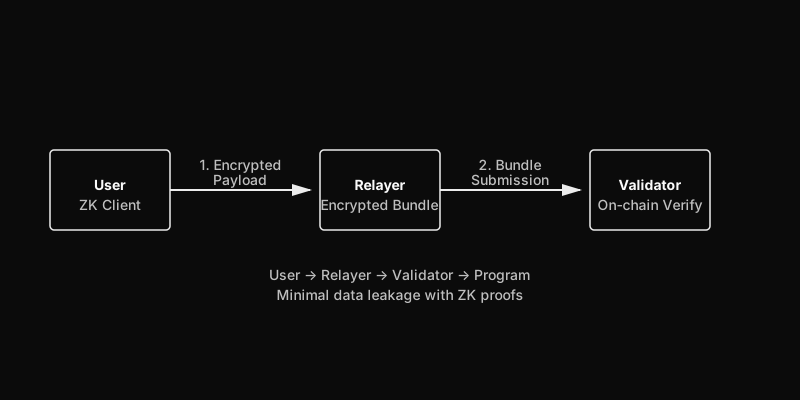
JitoMax.fun is presented as a concrete integration surface: client proof generation, encrypted relay transport, and Solana-side verification.
Builds the proof in-browser, keeps private inputs local, and prepares only the public signals required for verification.
Encrypts the proof payload for the relayer recipient key before any bundle routing logic sees the transaction intent.
Receives encrypted bundles, quotes priority fees, tracks accepted submissions, and forwards validator-ready payloads.
Verifies proof integrity on-chain and commits a compact state transition instead of writing sensitive context.
Endpoints are wired into the browser client so builders can test request and response shapes immediately.
The REST contract covers commitments, proof generation, verification, bundle submission, and fee quotes.
The repository documents how client proof payloads map into relayer delivery and program verification.
Try the endpoints directly from the built-in REST client
The JitoMax Layer is a Solana privacy adapter centered on ZK proofs and encrypted bundle relay. It brings together:
JitoMax.fun exposes a small contract that can be implemented by real services later without changing the developer-facing flow:
/hash normalizes private inputs into a commitment./prove returns a proof and public signals for a named circuit./verify checks the proof envelope before submission./bundle/submit accepts encrypted payloads for relayer delivery./fees/quote estimates priority fee requirements for bundle routing.The Playground provides mock endpoints so the full flow can be tested in the browser.
This site models the interaction flow rather than shipping production cryptography.
The mock layer imitates Poseidon hashing, proof verification, and relayer behavior.
Real circuits and programs require a full audit before mainnet use.
POST /hash → create a commitmentPOST /prove → generate a proof for the relationPOST /verify → validate proof integrityPOST /bundle/submit → deliver the encrypted payload through the relayer